
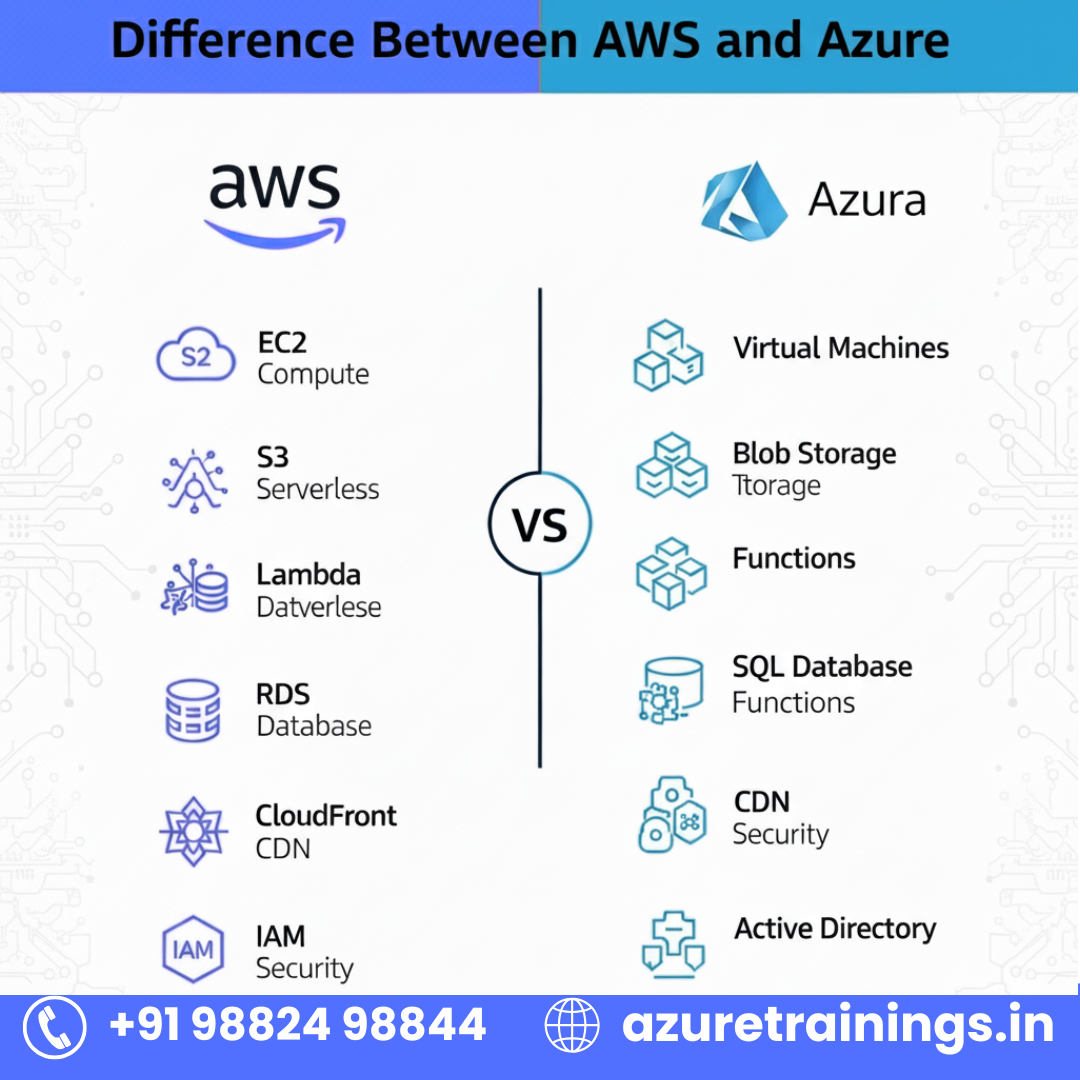
Two certification programs dominate enterprise cloud hiring. AWS has broader market share; Azure has deeper penetration in Microsoft-centric organizations. Choosing between them isn't a question of which cloud is "better" — it's a question of where your target employers operate and what skills your current environment uses.
Here's a comparison that goes beyond marketing talking points.
Market Share and Job Availability
AWS holds approximately 32% of the cloud market. Azure holds approximately 22%. But market share doesn't directly translate to certification value — what matters is where certified professionals are hired.
AWS advantage in: startups and technology companies, organizations that don't have significant on-premises Microsoft infrastructure, companies with polyglot technology stacks (Linux-first, multiple databases), and organizations outside of Europe (AWS has stronger adoption in North America and Asia Pacific).
Azure advantage in: organizations running Microsoft 365 (Office 365, Teams, Exchange Online), enterprises with existing Microsoft licensing agreements (Azure Hybrid Benefit makes Azure economically attractive), government and regulated industries (Azure Government has broader FedRAMP High authorizations), and European enterprises with Microsoft heritage.
The practical test: search LinkedIn for cloud engineer/architect roles in your target companies and cities. Count which certifications appear in job requirements. That data matters more than global market share statistics.
Certification Structure Comparison
| Level | AWS | Azure |
|---|---|---|
| Foundational | CLF-C02 (Cloud Practitioner) | AZ-900 (Fundamentals) |
| Administrator/Ops | SOA-C02 (SysOps) | AZ-104 (Administrator) |
| Developer | DVA-C02 (Developer) | AZ-204 (Developer) |
| Architect | SAA-C03 (Architect Associate), SAP-C02 (Architect Pro) | AZ-305 (Architect Expert) |
| DevOps | DOP-C02 (DevOps Engineer Pro) | AZ-400 (DevOps Engineer Expert) |
| Security | SCS-C02 (Security Specialty) | AZ-500 (Security), SC-100 (Architect) |
| Networking | ANS-C01 (Networking Specialty) | AZ-700 (Networking) |
Key structural difference: AWS has both an Associate and Professional tier for architects and DevOps. Azure combines these into a single Expert level. AWS SAA-C03 (Solutions Architect Associate) is roughly equivalent to Azure AZ-104 in terms of level, but AWS SAP-C02 (Solutions Architect Professional) maps closer to Azure AZ-305.
AWS depth advantage: AWS has more specialty certifications (Machine Learning, Data Analytics, Database, Advanced Networking, Security, SAP on AWS) and more distinct exam tiers. Candidates who want to specialize deeply in a technical domain have more certification options in the AWS track.
Azure breadth advantage: Azure has certifications across more Microsoft product areas — Dynamics 365, Power Platform, Microsoft 365 — which creates value for professionals working in the broader Microsoft ecosystem beyond infrastructure.
Exam Difficulty and Pass Rates
Neither AWS nor Microsoft publishes official pass rates. Community data from certification forums and training providers gives approximate pictures:
| Exam | Approximate first-attempt pass rate |
|---|---|
| AWS CLF-C02 | 70-75% |
| AZ-900 | 75-80% |
| AWS SAA-C03 | 55-65% |
| AZ-104 | 50-60% |
| AWS SAP-C02 | 40-50% |
| AZ-305 | 45-55% |
| AWS SCS-C02 | 45-55% |
| AZ-500 | 40-50% |
| AWS ANS-C01 | 35-45% |
| AZ-700 | 45-55% |
Important caveat: these are community estimates. Actual pass rates vary significantly by candidate background and preparation quality.
Question format differences: AWS exams use scenario-based questions with four options (one correct, three distractors). Azure exams use a wider variety: multiple choice, multiple select, drag-and-drop ordering, case study questions, hot area (click-on-image), and build-list. Azure's format variety catches candidates who only practice multiple choice.
Technical Content Differences
Networking
AWS networking concepts for exam: VPC, subnets, route tables, internet gateways, NAT gateways, VPC peering, Transit Gateway, Direct Connect, Site-to-Site VPN, CloudFront.
Azure networking concepts for exam: VNet, subnets, NSGs, ASGs, route tables, internet gateways (handled differently), NAT Gateway, VNet peering, Virtual WAN, ExpressRoute, VPN Gateway, Azure Front Door.
The networking models are conceptually similar but use different terminology and implementation details. AWS VPCs and Azure VNets serve the same purpose; the peering models and gateway architectures differ. Certified professionals in one platform can learn the other's networking model in days, but the exam questions test the specific details.
Identity
AWS identity: IAM (users, groups, roles, policies), AWS Organizations, SCPs. IAM is a single service.
Azure identity: Azure AD (now Microsoft Entra ID) is a distinct product from Azure RBAC. Azure AD handles identity (users, authentication, app registrations, enterprise applications). Azure RBAC handles resource access (who can do what with Azure resources). Understanding this split is foundational for Azure identity questions.
For candidates moving from AWS to Azure: the mental model shift is significant. AWS IAM handles both authentication and resource authorization in one system. Azure separates identity (Azure AD) from resource authorization (RBAC), which creates more flexibility but also more concepts to understand.
Managed Services Philosophy
Both clouds promote managed services, but the default assumption differs:
AWS: Amazon manages the underlying infrastructure, you manage the configuration and application layer. EC2 still requires you to manage the OS. RDS manages the database engine but not your schema or queries.
Azure: Microsoft's App Service, Azure Functions, and Azure SQL Database abstract away more by default. Azure SQL Database is more opinionated — it doesn't expose all SQL Server features, but the managed experience is more complete for what it does support.
"Coming from AWS to Azure, the thing that surprised me most was how opinionated Azure services are. AWS services expose more raw capability but require more configuration decisions. Azure services have more defaults and guardrails, which is actually faster for most use cases — but it means fewer knobs to turn when you need them." — Sam Cogan, Azure MVP, in Microsoft Tech Community blog
Cost of Certification
AWS exam pricing is simpler:
| AWS exam type | Cost |
|---|---|
| Foundational | $100 |
| Associate | $150 |
| Professional | $300 |
| Specialty | $300 |
Microsoft uses a different structure:
| Azure exam type | Cost |
|---|---|
| Fundamentals | $165 |
| Associate | $165 |
| Expert | $165 |
All Microsoft exams cost the same regardless of level. AWS charges more for professional and specialty exams. Over a full certification track:
AWS foundational + associate + professional: $550
Azure fundamentals + associate + expert: $495
Renewal cost: AWS charges full exam price to renew (or higher-level exam). Microsoft provides free online renewal assessments. For multi-certification professionals, Microsoft's renewal model is significantly cheaper long-term.
Exam vouchers and discounts: both programs offer discounts for exam retakes through their respective discount programs. AWS Certification offers 50% off a retake if you fail. Microsoft offers similar retake discounts. Microsoft also provides free exam vouchers to successful completers of some Microsoft Learn courses, which reduces cost for diligent learners.
Learning Resources Comparison
The ecosystems around each certification differ in ways that affect preparation quality:
AWS learning ecosystem:
Adrian Cantrill (learn.cantrill.io): lab-heavy, scenario-focused, premium
Stephane Maarek (Udemy): comprehensive, regularly updated, large student base
Jon Bonso/Tutorials Dojo: best practice exams in the ecosystem
acloud.guru (Pluralsight): broad coverage, hands-on labs
Free: AWS Skill Builder (official), A Cloud Guru free tier
Azure learning ecosystem:
John Savill (YouTube, NTFAQGuy): free, comprehensive, Microsoft MVP — best free resource in either ecosystem
Thomas Itzelberger (Udemy): detailed AZ-104 and AZ-305 coverage
Official Microsoft Learn: free, aligns exactly with exam objectives, sandbox labs
Tutorials Dojo: practice exams for Azure, same quality as AWS exams
Free: Microsoft Learn paths (complete, high quality)
Advantage: Microsoft Learn is genuinely excellent — free, comprehensive, written by the product teams, with integrated sandbox labs. AWS Skill Builder is free but less comprehensive than Microsoft Learn. Candidates who commit to Microsoft Learn plus John Savill's YouTube content have a competitive preparation path that costs nothing.
Making the Decision
Choose AWS if:
You're targeting technology companies, startups, or organizations without a Microsoft heritage
You want more specialty certification options for deep technical specialization
Your current employer uses AWS and will pay for AWS certification preparation
The job postings in your target market consistently list AWS certifications
Choose Azure if:
Your target employers run Microsoft 365 and have Microsoft enterprise agreements
You're targeting European enterprises or government/regulated sectors with strong Microsoft presence
Microsoft's free learning resources (Microsoft Learn + Savill's YouTube) are sufficient for your learning style
You prefer annual renewal assessments (free) over triennial full re-exams
Start both if you're undecided: AZ-900 and CLF-C02 together take 6-8 weeks and $265. Completing both fundamentals exams gives you enough exposure to both ecosystems to make an informed decision about where to invest for associate-level study. This isn't the most efficient path, but it's a valid one for genuinely undecided candidates.
The most common mistake: pursuing the platform that sounds more impressive rather than the one aligned with your target employers. An Azure certification in an AWS shop is less valuable than an AWS certification regardless of technical content quality.
Detailed Track Comparison: AWS vs Azure by Role
For each common cloud role, the direct certification equivalents and what the content difference means in practice:
| Role | AWS Certifications | Azure Certifications | Key Content Difference |
|---|---|---|---|
| Cloud admin / sysops | SOA-C02 (SysOps Administrator) | AZ-104 (Administrator) | SOA-C02 emphasizes automation and monitoring; AZ-104 covers broader AD integration |
| Solutions architect | SAA-C03 + SAP-C02 | AZ-305 (single Expert exam) | AWS splits into two levels; Azure combines them |
| Developer | DVA-C02 (Developer Associate) | AZ-204 (Developer Associate) | Both test SDK and serverless; Azure tests Cosmos DB more heavily |
| DevOps | DOP-C02 (DevOps Professional) | AZ-400 (DevOps Expert) | Both test CI/CD; AZ-400 tests GitHub Actions specifically since 2023 |
| Security | SCS-C02 (Security Specialty) | AZ-500 + SC-100 | AWS is single exam; Azure security spans multiple credentials |
| Networking | ANS-C01 (Advanced Networking) | AZ-700 (Network Engineer) | Both test hybrid connectivity; ANS-C01 includes broader BGP/routing depth |
| Data engineering | DEA-C01 (Data Engineer Associate) | DP-203 (Data Engineer) | AWS tests Redshift, EMR heavily; Azure tests Synapse, Databricks, Data Factory |
| AI/ML | MLS-C01 (Machine Learning Specialty) | AI-102 (AI Engineer) + DP-100 (Data Scientist) | AWS is single exam; Azure splits AI services from ML platform |
This table reveals a consistent pattern: AWS tends toward fewer, deeper certifications; Azure tends toward more certifications with narrower scope per exam.
Why Azure Certifications Have Free Annual Renewal
Microsoft's free renewal model is not a marketing tactic — it reflects a deliberate philosophy about certification maintenance, and understanding the mechanism explains why it works differently from AWS.
The mechanism: when an Azure certification approaches its one-year expiration date, Microsoft makes a renewal assessment available through Microsoft Learn (not Pearson VUE). The assessment is 20-30 questions, untimed, free, and can be retaken if failed after a 24-hour waiting period. No proctoring. Passing it extends the certification for one more year.
Why Microsoft chose this model: Azure services update more rapidly than AWS in many areas, and Microsoft prioritizes currency over durability. A one-year cycle with free renewal forces certified professionals to demonstrate they're tracking new services and capabilities — making certifications better signals of current Azure knowledge than a three-year-old AWS cert. From Microsoft's perspective, the renewal data also provides valuable feedback on which new features are being adopted.
The practical difference for multi-cert holders: an AWS professional holding SAA-C03, DOP-C02, SCS-C02, and ANS-C01 faces $1,200+ in renewal fees every three years ($300 each). An Azure professional holding AZ-104, AZ-305, AZ-500, and AZ-700 renews all four annually for free. Over a five-year career holding both tracks, the cost difference compounds significantly.
"I've held multiple Azure certifications for four years. The annual renewal assessments take 45 minutes to an hour if you've been keeping up with Azure announcements. For AWS, renewal means re-studying for a full exam at $300 a attempt. Azure's model is demonstrably better for professionals who maintain active cloud skills — the burden scales with your actual knowledge currency, not a fixed retake price." — Sam Cogan, Azure MVP, Azure Community Hub
Hybrid and Multi-Cloud Career Value
The cloud market has moved significantly toward multi-cloud deployments, and this creates meaningful differentiation for certified professionals:
Why multi-cloud certification matters now: enterprise cloud surveys (including Flexera's State of the Cloud Report) consistently show 87-92% of enterprises use multiple cloud providers. The days of pure AWS or pure Azure shops are less common than single-vendor cloud architectures. Architects who understand both platforms command premium compensation.
The AZ-104 + SAA-C03 combination: holds roughly the same value as a specialist depth in either platform, but with significantly broader applicability. Enterprise architects in multi-cloud environments who can bridge AWS and Azure configuration are relatively rare — the market recognizes this with compensation premiums.
Hybrid cloud scenarios that require both: Azure Arc (Azure management plane over AWS and other clouds) and AWS Outposts (AWS on-premises) create specific use cases where cross-platform knowledge is required, not just preferred. Azure Arc administrators need AZ-104-level Azure knowledge but may manage resources running on AWS — requiring familiarity with both environments.
Microsoft Entra ID in multi-cloud contexts: many organizations use Microsoft Entra ID (Azure AD) as the identity provider even in AWS-primary environments — because their user population is already in Microsoft 365. SC-300 or AZ-104-level Entra ID knowledge has value in organizations that are AWS-first but Microsoft-identity-first. This is a specific hybrid credential value that isn't obvious from track descriptions.
Salary Comparison: AWS vs Azure Certified Professionals
Job function-matched salary comparisons for US market, 2024:
| Job Function | AWS Certified | Azure Certified | Differential |
|---|---|---|---|
| Cloud administrator | $105,000-$130,000 | $100,000-$125,000 | AWS ~4% higher |
| Solutions architect | $145,000-$175,000 | $140,000-$172,000 | AWS slight edge |
| DevOps engineer | $120,000-$155,000 | $118,000-$150,000 | Roughly equivalent |
| Cloud security engineer | $130,000-$165,000 | $128,000-$162,000 | Roughly equivalent |
| Data engineer (cloud) | $115,000-$148,000 | $118,000-$150,000 | Azure slight edge |
| Full-stack cloud architect (both certs) | $165,000-$210,000 | N/A — requires both | Multi-cloud premium |
The salary differential between AWS and Azure for equivalent roles is smaller than many candidates expect — typically 0-5% in AWS's favor for infrastructure and architecture roles. The multi-cloud premium for holding both at the associate level or above is more significant (10-20% above single-platform specialists).
Market nuance: salary comparisons mislead when they ignore industry. AWS-certified professionals in technology and startup sectors earn at the high end of these ranges. Azure-certified professionals in finance, healthcare, and government (where Azure has stronger penetration) may earn at or above equivalent AWS professionals in those sectors.
Industry Breakdown: Which Employers Prefer AWS vs Azure
Understanding where each platform concentrates helps prioritize certification investment:
Industries favoring AWS certification:
Technology companies and software startups: AWS leads in this segment due to early cloud adoption and broad service breadth
Media and entertainment: streaming infrastructure historically built on AWS
E-commerce and retail tech: AWS's origin story (Amazon retail) carries deep expertise
International technology operations in APAC and North America without Microsoft heritage
Industries favoring Azure certification:
Healthcare: Epic EHR, many EMR systems integrate with Azure; Microsoft 365 compliance features align with HIPAA requirements
Finance and banking: Azure has strong penetration in European financial services; US banks with Microsoft infrastructure use Azure for hybrid scenarios
US Federal government and defense: Azure Government has FedRAMP High authorization; DoD uses Azure at scale (JEDI controversy aside)
Education: Microsoft's academic licensing and Teams adoption drives Azure use
Manufacturing and OT environments: Azure IoT and Azure Arc are Microsoft-specific technologies used in manufacturing digital transformation
The swing sectors — technology consulting and managed services — hire for both and often pay premium for dual-certified professionals. SI partners (Accenture, Capgemini, Deloitte, Wipro) value both Azure and AWS certifications as client contract qualifications.
Market Share Trajectory and Certification ROI
AWS's cloud market share has gradually declined from a 2017 peak of approximately 47% to approximately 32% in 2024. Azure has grown from roughly 10% to 22% over the same period. This trend matters for certification ROI because:
The narrowing gap reduces AWS advantage: as Azure penetration increases in enterprise accounts, the number of Azure-specific job openings grows faster than AWS openings in those sectors. For candidates targeting enterprise IT roles specifically, Azure's growth trajectory is more favorable than a static market share snapshot suggests.
Don't overcorrect on trends: AWS remains the larger platform by revenue and total workloads. A certification decision based on multi-year trend projections ignores the job market that exists today. The practical test remains: check actual job postings in your target sector and geography. National trends may not reflect local or industry-specific patterns.
The Google Cloud wildcard: Google Cloud Platform (GCP) holds roughly 11% market share and is growing. GCP certifications (Associate Cloud Engineer, Professional Cloud Architect) are less widely required than AWS or Azure but command premium compensation in markets where GCP is used. Candidates who reach associate-level in AWS or Azure and want additional differentiation should evaluate GCP before adding a second certification in their primary platform.
See also: Microsoft Azure certifications roadmap: which order makes sense, AWS Specialty certifications ranked: which ones are worth pursuing
References
Synergy Research Group. Cloud Market Share Report Q4 2024. Synergy Research, 2024. (Quarterly cloud market share tracking across major providers)
Microsoft. Microsoft Learn — Azure Certifications. Microsoft Learn, 2024. https://learn.microsoft.com/en-us/certifications/browse/?products=azure
Amazon Web Services. AWS Certification — Exam Pricing. AWS, 2024. https://aws.amazon.com/certifications/
Savill, John. Microsoft Azure Master Class. YouTube/NTFAQGuy, 2024. (Microsoft MVP; 30+ hour free Azure training series used by hundreds of thousands of learners)
LinkedIn Economic Graph. Jobs on the Rise: Cloud Skills Demand Report 2024. LinkedIn, 2024. (Data on cloud certification demand across industries and geographies)
Tutorials Dojo. AWS vs Azure Certification Comparison — Community FAQ. Tutorials Dojo Blog, 2024. https://tutorialsdojo.com/blog/ (Practitioner perspective from the AWS/Azure certification preparation community)
Frequently Asked Questions
Should I get AWS or Azure certified first?
Choose based on where your target employers operate. Search LinkedIn job postings for your target role in your target location. Count which certifications appear in requirements. That data is more reliable than global market share statistics. AWS has more jobs overall; Azure dominates Microsoft-centric enterprise environments.
What is the cost difference between AWS and Azure certifications?
AWS charges \(100 (foundational), \)150 (associate), and \(300 (professional/specialty). Microsoft charges \)165 for all levels — fundamentals through expert. Microsoft’s annual renewal assessments are free; AWS charges the full exam fee for renewal. For multi-certification professionals, Microsoft’s total cost is lower.
Are AWS or Azure exams harder?
Comparable at equivalent levels. Both have approximately 55-65% first-attempt pass rates at the associate/administrator level. Azure exams use more question format variety (drag-and-drop, hot area, case studies) that can catch candidates who only practice multiple choice. AWS exams are more consistently scenario-based.
Is Microsoft Learn good enough to pass Azure exams?
For AZ-900, yes. For AZ-104 and above, Microsoft Learn is excellent as the primary content source but should be supplemented with John Savill’s YouTube content (for conceptual clarity) and Tutorials Dojo practice exams (for question-pattern training).
Should I get both AWS and Azure certified?
Generally no — at least not both fundamentals credentials. Time spent on a second cloud fundamentals certification is time not spent on a technical certification in either platform. Pick one platform, go deep to associate or professional level, then consider cross-platform study only if your role genuinely requires both.